What an Omnichannel Retail Strategy Actually Requires Behind the Scenes
“Omnichannel” gets thrown around so often it’s started to lose meaning. Most retailers already sell online and in a physical store, which sounds like omnichannel on paper. But ask a customer who tried to return an online order in-store, or found a product listed as available when it wasn’t, and they’ll tell you the experience didn’t feel connected at all.
That gap – between what a strategy claims and what a customer actually experiences – is where most omnichannel efforts quietly fail.
What Omnichannel Really Means
A genuine omnichannel retail strategy treats every sales channel as one system, not several systems that happen to share a logo. A customer should be able to browse online, buy in-store, return through either, and see accurate stock information no matter where they’re looking. The channel they use shouldn’t change what they know or what they can do.
That sounds obvious. Getting there is not.
Where These Strategies Usually Break Down
Three problems show up again and again once a retailer expands past a single channel:
Inventory drifts out of sync. A product sells in-store, but the website still shows it in stock for another few hours. Orders pile up manually. Someone on staff is copying Shopify orders into a POS system by hand, which works fine until volume climbs and mistakes start slipping through. And product details stop matching – a price or description gets updated in one place and never makes it to the other.
None of these are strategy failures, exactly. They’re operational ones. And they all trace back to the same root cause: systems that don’t talk to each other.
Inventory Has to Be Accurate Everywhere, All the Time
Nothing damages trust faster than a customer ordering something that isn’t actually there. In a multichannel business, that usually happens because in-store sales and online sales aren’t updating the same inventory count in real time.
Fixing this isn’t about hiring more staff to check stock manually – it’s about making sure a sale in one place immediately reflects everywhere else, without anyone touching a spreadsheet.
Orders Need to Move in Both Directions
Order data is just as easy to lose track of as inventory. When online orders don’t flow automatically into whatever system handles fulfillment, someone ends up re-entering details by hand – customer information, line items, shipping addresses. Every manual step is a chance for something to go wrong, and at scale, something eventually will.
A connected setup means an order placed online shows up wherever fulfillment happens, with nothing retyped and nothing missed.
Pricing and Product Info Can’t Diverge
Customers notice when a price online doesn’t match what’s charged in-store, or when a product description reads differently depending on where they found it. It looks careless, even when it’s just a syncing gap. Keeping product data – SKUs, pricing, descriptions – consistent across every channel is less about technology and more about trust.
Supporting the Way People Actually Shop
Buy online, pick up in store. Return anywhere. Check availability before making the trip. These aren’t nice extras anymore – they’re close to expected. None of them work without accurate, shared inventory and order data behind the scenes. A retailer can advertise BOPIS all they want, but if the backend systems aren’t actually connected, the promise falls apart the first time a customer tries to use it.
Scaling Without Losing Control
Everything above gets harder, not easier, as a business grows. Add a second location, a third sales channel, or a seasonal spike in order volume, and manual processes that were merely annoying at a small scale become genuinely unmanageable. The retailers who scale smoothly are usually the ones who solved the sync problem early, before volume made it painful.
Where a Tool Like Lightspeed Shopify Integration Comes In
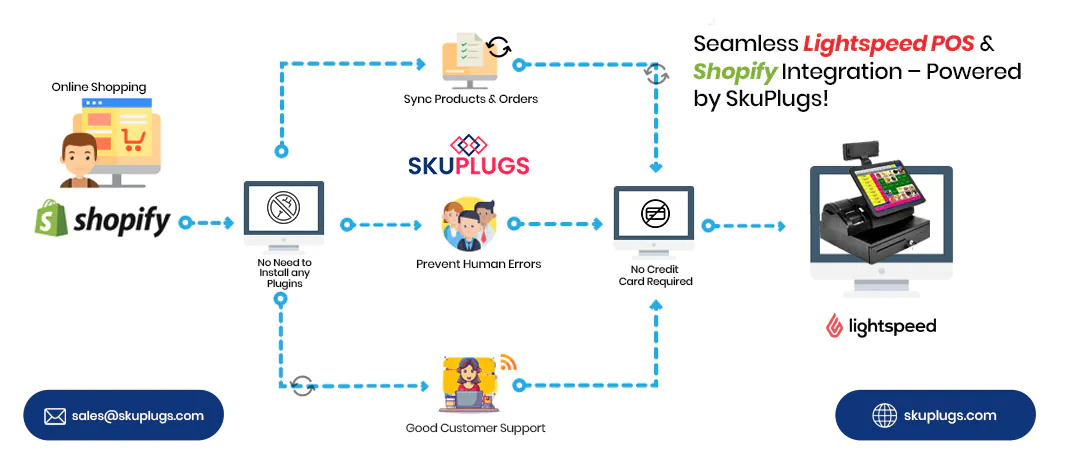
This is the part where most retailers realize a strategy alone isn’t enough – it needs a mechanism to actually run on. Connecting a POS system like Lightspeed with an online storefront like Shopify is one practical way to make the pieces above happen automatically: inventory synced in real time, orders flowing without manual entry, and product data staying consistent no matter which channel a customer touches.
SKUPlugs builds that connection – real-time sync, accurate order routing, and product mapping that holds up as a business adds locations or channels. It’s not the strategy itself, but it’s the plumbing that lets the strategy actually work.
If you’re building toward a real omnichannel setup and want the backend to match the ambition, see how SKUPlugs connects Lightspeed and Shopify.
